
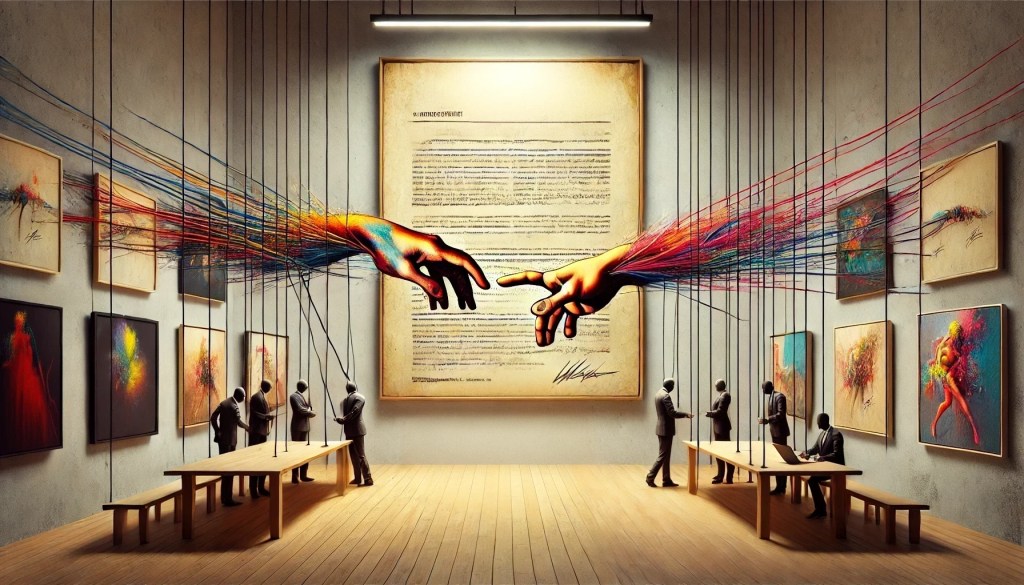
In the art world, contracts are more than just legal formalities—they are crucial tools for protecting the rights, interests, and creative outputs of all parties involved.
This is the first in a series of articles discussing contracts in the art world which will cover both the scope and role of contracts in this context, as well as offer some fascinating real life accounts of what can go wrong if agreements break down (or are not properly considered and recorded in the first place).
Other topics, for example, fine art insurance; resale rights; and certain specific transactions like loans of works; consignment and commission agreements, among others, also touch on matters that are fundamentally contracts, or at least are connected to contracts, between art market participants.
To get the most out of these articles (or if you are simply looking for a primer on the topic of contracts in the art world or otherwise), it is necessary to know a little bit about how contracts work. This article seeks to do that, with a short explanation of some basic concepts, followed by some links to external pages that can help you learn more about the legal ins and outs of contracts in New Zealand law.
This is of course is simply a general overview of these matters, and far from comprehensive advice. There can be an awful lot of subtlety to contractual issues, so if you are looking to document a deal; need advice about a particular contract; or are involved in a dispute over one and feel like you need some help, we strongly recommend you instruct a lawyer. You can contact us here.
What is a Contract?
At it’s heart, a contract is a legally enforceable agreement between two or more persons. Put another way, every contract is an agreement, but not every agreement is a contract. For an agreement to reach the threshold to be considered a contract and thus legally enforceable, a few essential elements must be present:
- One party must make an offer;
- The other must accept it;
- Something of value (consideration) – like money, goods or services – must be exchanged;
- Both parties must intend to create legal obligations, knowing that the agreement isn’t just a casual discussion. For example, casual promises made between friends, or family arrangements with no intent to be legally bound, are typically not enforceable (see here for an example);
- Finally, the terms of the contract need to be certain. This means the important details necessary to make the contract work must be clear. What is necessary for this will depend on the transaction in question, but generally this will include at the least details like the identity of the parties; what is being provided and/or paid; and when how and by who this is being done etc. If the terms of the agreement are too vague or uncertain, it may not form a valid contract at all.
On top of these points, in certain circumstances the law considers otherwise valid contracts to be void (i.e. invalid from the moment that it was entered into and thus not legally binding), or the courts can declare a contract to be void, canceled, or otherwise unenforceable. These include:
- If a party to the contract does not have capacity to contract. Capacity basically boils down to a person being considered at law as being capable of making an agreement. For example, minors (those under 18) or people lacking mental capacity may not be able to form legally binding agreements;
- Similarly, if a contract is formed where one party was under duress or the undue influence of another person may not be enforceable;
- If a contract is illegal in its creation or performance it will be considered to be void (in whole or in part);
- In certain circumstances, if one or both parties to a contract have made a material mistake when entering into the contract the court may cancel it;
- Breaches of certain laws can make the contract void. For example, a court may declare a contract void as a result of breaches of the Fair Trading Act 1986;
- Contracts that are contrary to public policy can be void in whole or in part too (restraints of trade which are considered excessive are a classic example of this); and
- In certain circumstances, contracts may also be void if entered into when one of the parties does not have the legal right to do so, or if a party is breaching a duty to another person by entering into the contract.
What does a contract need to have?
Contracts needn’t be complex. Generally, so long as the parties to the contract are meeting the requirements above, they will be free to negotiate whatever terms they want in a contract (subject to their respective bargaining power of course).
Terms Implied by Law
Some terms are however automatically included in a contract by law, even if they’re not mentioned in the contract itself. There is quite a few such laws, and it is beyond the scope of this article to list them all. But for example, when selling a “good” such as a painting, the law implies that the artwork must match any description given, and that the seller has the right to sell the work.
While parties can sometimes agree to modify or exclude some such implied terms, key protections (like those around misrepresentation or consumer rights) cannot always be contracted out of.
Do Contracts Need to Be in Writing?
Most contracts do not need to be in writing to be enforceable (there are exceptions, but most of these will not be particularly relevant in the art world).
Verbal agreements which meet the elements of a contract are therefore binding.
What if a contract goes wrong?
As the articles that will follow this one will demonstrate, if a contract ends up going wrong, things have the potential to become very messy indeed.
A contract can go sideways for numerous reasons, ranging from pre-contractual mistakes or misrepresentations; to a breach of the terms of the agreement by one or other party (such as failing to pay on time or failing to deliver); a refusal to perform (otherwise known as a repudiation), or even the impossibility of performance; and of course debates as to whether the contract is valid in the first place. And, as with everything we have touched on so far, there is a lot of possible nuance to how these matters might arise and play out.
The same also applies to the possible dispute resolution processes that might be available to resolve this. These can range from casual negotiations which could in theory resolve any issues amicably and within minutes; to more structured processes such as mediation; all the way to arbitration or civil court proceedings which could drag out over years; or, as we will see in future articles, even criminal processes.
Likewise, there is a lot to say about possible outcomes and remedies that could be agreed or ordered by a judge in different situations, not to mention the time, cost, and of course uncertainty, stress and hassle of the journey to get there (especially if lawyers and courts are involved).
A full explanation of these matters is beyond the scope of this article and is something that we may write about in more detail in the future. But in short, the approach to resolving any particular contractual problem will be highly dependent on the facts of the matter, the relationship between the parties, and the legal options that flow from that. Again, as noted above, if you are involved in a dispute over a contract (or are concerned that one may arise) and feel like you need some help, we strongly recommend you instruct a lawyer.
Other Resources
- Consumer.org.nz – Contract Law
- Consumerprotection.govt.nz – Fair Trading Act
- Consumerprotection.govt.nz – Consumer Protection Act
The information on this website is general in nature and may not be up to date. It is not intended as legal advice for any specific situation or person and should not be relied on for that purpose. You should always seek up to date legal advice for your specific situation.
Contact us to find out more.
 Lawof.Art
Leave a comment