
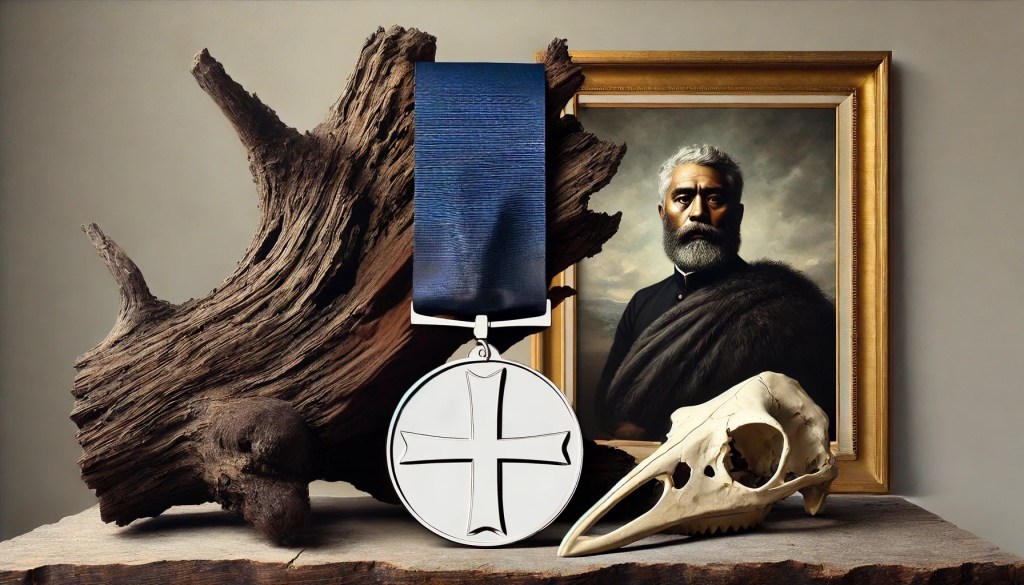
In an earlier article we wrote about export restrictions applying to items of cultural and scientific significance under the Protected Objects Act 1975. As we saw, one of the functions of the Act is to prohibit the unauthorised export of “protected New Zealand objects” from New Zealand without permission from the chief executive of the Ministry for Culture and Heritage.
This article looks at two examples of the Act in practice – first an application for the export of a George Cross, illustrating how the Ministry has approached such applications in the past; and the second, a series of Court decisions on whether the Act covers, of all things, the export of swamp kauri, which offers a view of how the judiciary see not only how the Act might apply to natural science objects, but also includes comments about how a judge might apply it to other possible protected New Zealand objects, from moa bones to works by iconic Kiwi artists.
These decisions collectively cast light on the scope of the export restrictions imposed by the Act
If you are considering exporting an object that may be covered by the Act, and need legal advice, please contact us to discuss.
For Gallantry
On 13th November 1990, Sergeant Guthrie of the New Zealand Police was killed in the line of duty, attempting to contain and apprehend a gunman who had massacred 12 people in the small Otago town of Aramoana.
He was posthumously awarded the George Cross, the highest award in the British Commonwealth for conspicuous gallantry not in the face of an enemy.
The Aramoana massacre was a shocking and defining event in New Zealand history; and a George Cross is a very rare medal, with only 407 having been awarded across the Commonwealth as at the time of writing. Of those, Sergeant Guthrie was the only civilian recipient of the George Cross in New Zealand, and one of only 4 New Zealanders awarded the medal before it’s replacement with the New Zealand Cross in 1999.
Sergeant Guthrie’s George Cross is therefore a unique and significant item, commemorating both his exceptional heroism but also serving as a reminder of the tragic events for which it was awarded.
It is also a special item for the purpose of the Protected Objects Act. Not only is the item intrinsically connected to New Zealand due to the circumstances of its award, but the Act specifically refers to examples of the New Zealand Cross, Victoria Cross, and George Cross, and their associated groups, awarded to a New Zealander or related to New Zealand, when defining protected New Zealand Objects.
In or around 2017, Sergeant Guthrie’s family, which had held his George Cross in New Zealand, decided to sell this to Lord Ashcroft, an English medal collector and philanthropist who holds the worlds largest collection of Victoria Cross and George Cross medals, housed in the Imperial War Museum, London. The family’s agent sought permission to export the medal.
Documents released about the application under the Official Information Act (and available online here) show the reports and recommendations to the Chief Executive of the Ministry of Culture and Heritage from the two expert examiners appointed to consider the case. In line with the criteria in the Act, both considered whether the medal was a protected New Zealand object covered by the Act; whether it was substantially physically authentic; and whether it was of importance to New Zealand. Unsurprising, both concluded that it was.
In consequence, the medal was found to be a protected New Zealand object, meaning permission from the Chief Executive was required for it to be exported, but only so long as the Chief Executive was empowered to do so under the Act. This depended on whether the experts considered that the export of Sergeant Guthrie’s George Cross would substantially diminish New Zealand’s cultural heritage or not. The reports show that both concluded that it would not, for reasons that included that other examples of the medal, awarded to other New Zealanders, are on display in the New Zealand National Army Museum, and with particular weight given the proposal that Sergeant Guthrie’s medal would be publicly displayed in context at the Lord Ashcroft Museum, where it could be viewed by New Zealanders and others.
Both experts however recommended conditions be imposed on the export permit, requiring the medal to be displayed in the collection. The export was approved by the Chief Executive on this basis.
For those unable to visit Lord Ashcroft’s collection in person, an image of Sergeant Guthrie’s medal, and the full citation for his award, can be found on the Lord Ashcroft Medal Collection website.
Swamp wood, dead moas and hypothetical Goldies
Between March 2017 to April 2018, the New Zealand Courts released a series of decisions in proceedings between the Northland Environmental Protection Society Inc, an environmental protection group, and the Chief Executive of the Ministry for Primary Industries, over whether swamp kauri could be exported from New Zealand or not.
In the High Court, Justice Toogood explained that:
The Waipoua Forest in Northland is home to New Zealand’s mightiest kauri tree, Tane Mahuta, and many other great agathis australis specimens. The forest is a national taonga which is protected as a remnant of the magnificent kauri forests which covered the Far North and spread as far south as the Kawhia Harbour. Those forests were decimated in the 18th and 19th centuries, but the relics of fallen trees have lain buried in swamp land for centuries; some for many thousands of years. The unique swamp conditions have preserved the timber intact. Located almost exclusively under areas of farmland and wetland in Northland, ancient swamp kauri stumps and logs are highly prized. Over the past five years, a sizeable industry in the excavation, milling and export of ancient swamp kauri and its products has developed.
One of the various arguments raised by the Society to try to halt the unregulated export of swamp kauri from New Zealand was that the Protected Objects Act applied universally to all swamp kauri, meaning no example or product made from this could be exported without approval of the Chief Executive of the Ministry for Culture and Heritage.
Essentially, it was argued that swamp kauri should fall within the scope of protected New Zealand objects under the category for “natural science objects” of cultural significance.
The argument was rejected by the courts at all levels. Specifically, it was considered that the Act was not intended, and should not apply, to entire species or classes of object.
Of note, Justice Toogood found:
The scheme of the Act is directed towards the protection of individual objects or collections of objects which form part of New Zealand’s important cultural heritage.
And:
the scheme of the Act is to protect certain objects of particular national value, not to create sweeping export restrictions on entire categories of object such as bulk natural materials.
The Court of Appeal and Supreme Court agreed, with the later stating:
The purpose of the Protected Objects Act is to protect certain objects of particular national value to New Zealand. The focus is therefore on individual items that, as individual items, have significance for one or more of the reasons set out in s 2(1)(a). The Act is not designed, as the Courts below held, to protect natural materials such as swamp kauri in bulk. It is true that protected New Zealand object is defined to include a collection or assemblage of objects but these terms imply that the collection or assemblage is in one place or in the hands of one owner. That does not apply to swamp kauri.
Further, to require all pieces of a bulk natural material, such as swamp kauri, to be subject to an application process before export would create a major administrative burden, both on the Ministry and the public. This cannot have been the intention of the Act. It is true that an exemption could be granted if there are sufficient examples of swamp kauri in public ownership but, if swamp kauri generally had been intended to be covered by the Act, this then raises the question, given the finite nature of the resource, as to what would be a sufficient amount in public ownership in order for it to satisfy the criteria for an exemption
While this may all seem very niche, in the course of their decisions the courts also offered more general guidance to the application of the Act, both in practice and in theory. Justice Toogood noted that:
The Ministry’s submissions included an example of the way in which the Ministry adopts a practical, case by case approach to applications for the export of moa bones, which are listed in Schedule 4 of the Act. The evidence of Dr David Butts for the Ministry explained that two cases considered by the Ministry under the Act involved a conclusion that the moa bone samples concerned did not meet the definition of a protected New Zealand object, because they did not meet the additional criteria of rarity and natural science significance.
Finally, the Court of Appeal provided an example of how the Act might potentially apply to an iconic New Zealand artist:
[64] …. Take as an illustration paintings by Goldie. Art objects are in category 2 of sch 4, which specifically includes paintings. Individually each painting would be an object forming part of the movable cultural heritage of New Zealand, and of importance to New Zealand for aesthetic, artistic, cultural, historical or traditional reasons. However, cl 2(2) of sch 4 provides:
- “(2)An object is included in this category if it is—
- (a)not represented by at least 2 comparable examples permanently held in New Zealand public collections; and
- (b)made by—
- (i)an artist or maker born in or related to New Zealand and who is no longer living; or
- (ii)a living artist or maker born in or related to New Zealand where that artist or maker is not the owner; and
- (c)not less than 50 years old.”
[65] It can be seen that cl 2(2)(b)(ii) operates so as to reduce the number of items that might otherwise be captured as being within category 2. The reduction is on the basis of scarcity; death of the artist or, in the case of a living artist, the fact that the painting has passed out of his or her ownership; and age, by requiring that the painting be not less than 50 years old.
[66] In terms of the definition of “protected New Zealand objects”, the Goldie paintings are within para (a), but will not fall within para (b), because they would not be within a category of protected objects in sch 4. Although paintings are mentioned in cl 2(1) of that schedule, the requirements of cl 2(2) are not met because there are obviously more than two comparable examples permanently held in New Zealand public collections.
The point of these comments was to illustrate the narrow application of the Act to individual items or specific collections of national cultural significance. But they are potentially informative in terms of how the courts and the Ministry might see the Act applying to something like moa bones or paintings by significant New Zealand artists.
The information on this website is general in nature and may not be up to date. It is not intended as legal advice for any specific situation or person and should not be relied on for that purpose. You should always seek up to date legal advice for your specific situation.
Contact us to find out more.
 Lawof.Art
Leave a comment